
 Mitigation
Program
Best Practices Management
Mitigation
Program
Best Practices Management
INTRODUCTION
As coastal development proliferates throughout the Caribbean, it is essential that countries focus on potential long-term impacts and incorporate science, tools and methods to protect coastal environments. The rationale of sustainable development is that the susceptibility of the environment can be documented, managed and mitigated, thus preventing negative impacts. To ensure environmental health and compliance, an overall development strategy must incorporate proper planning, clear, ambient environmental quality standards and continuous monitoring.
Using developments in The Bahamas as models, these principles have been incorporated to develop Environmental Impact Assessments (EIA) and Best Management Practices, Environmental Management Programs (EMP), a Sea Turtle Protection Plan, an Integrated Pest Management Plan (IPMP) and outreach materials. From similar studies and long-term monitoring, the usefulness of many of these strategies to minimize impacts on coastal and near shore communities has been verified. These strategies and materials encompass the broader principles of sustainable coastal development and are applicable to similar situations throughout the Caribbean.
The main threats to small island environments from development stem from:
· Pollution of the island environments, leading to a loss of biological diversity and wildlife habitat degradation
on the land and in the sea;
· Loss of critical habitats for wildlife on and around the island in the land cover conversion; and
· Increased sediment run-off and erosion due to large-scale vegetation loss in the construction phase of
the development.
Case study: Baker’s Bay Golf and Ocean Club (BBC)
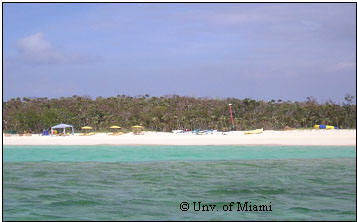
Vision for the Development
The developers advocate using the full resources of
their partnerships to enable this development to be a source
of pride for its members and residents, for the Government
of The Bahamas and for the residents of Guana Cay.
The developers will strive to incorporate multiple development strategies, including:
Environmental sensitivity in both practice and outreach educational programs
Bahamian-influenced architectural styles
Materials and infra-structure appropriate for the small island setting,
Socio-economic integration of BBC with both the local and regional communities.
The design philosophy is to use the best available technologies to construct a residential resort community with the highest environmental standards and management practices. Simple techniques, such as landscape planning, incorporation of coastal setbacks and coastal buffer zones, preserve areas and invasive species removal have already proven key for coastal stability, run-off filtration and the maintenance of biodiversity in onshore and offshore habitats. Also, the development creates a variety of jobs both on-site and in Marsh Harbour.
Environmental Impact Assessment (EIA)
EIA is an internationally recognized and structured approach to acquiring and evaluating environmental information about the prospective impacts of a physical development, and is used in decision-making in the development process (UNEP 2005). Post EIA monitoring and auditing, the actual impacts that occur as a result of development has been commonly recognized as a means by which a feedback mechanism can be established in EIA (Wood 2000). Thus, establishing a process to track compliance with any management and mitigation measure proposed in the EIA should be incorporated into development (UNEP 2005). Accordingly, a prescriptive EIA was developed with defined environmental goals and an auditing mechanism.
Þ Document best practices in sustainable development in The Bahamas.
Þ Report on the performance of the Baker’s Bay Club development in meeting prescribed environmental goals.
The overall environmental goals of the Baker’s Bay Club are (EIA, 2004):
1. To maintain representation of all the natural vegetation communities on the island.
2. To maintain water quality parameters in coastal groundwater and near shore marine waters at pre-construction
levels.
3. To enhance wildlife habitat quality in the coastal zone, wetlands and preserve areas, with measurable increases in
targeted conservation species.
4. To maintain coastal stability with the measurable maintenance of beaches, and natural recovery of beaches from
storm disturbances.
The EIA Summary created for Baker's Bay Golf and Ocean Club (edited by Media Enterprises Ltd, Nassau)
Environmental Management Program (EMP) and Support Documents
A multi-faceted EMP was developed to track and monitor EIA compliance and measure the success of the prescribed development strategies in mitigating environmental impacts. Components of the EMP include: a) a mitigation program for ecologically-disturbed areas; b) Best Management Practices (BMPs) for site design and construction; c) an ecological monitoring program; and d) Waste Management and Integrated Pest Management Plans (IPMP); and e) a formal reporting and feedback system. Tools and methods employed in the EMP to monitor and measure will supply data and information pertinent to understanding the costs, requirements and mitigations necessary for sustainable coastal
development in the Caribbean.
The Environmental Management Program created for Baker’s Bay Golf and Ocean Club
Integrated Pest Management Plan
BMPs for site design and construction
References
UNEP and World Tourism Organization. 2005. Making Tourism More Sustainable. A Guide for Policy Makers.
Wood, g. 2000. Is what you see what you get?: Post-development auditing of methods used for predicting the zone
of visual influence in EIA. Environmental Impact Assessment Review. Vol 20: 5. 537-556.
 Coastal Ecology of the
Bahamas
Coastal Ecology of the
Bahamas